
Author: Lando Rothbardian

  • Book a Flight With No Email, No Phone Number — Paid in Crypto: Introducing ShopinBit Privacy Shield

    Book a Flight With No Email, No Phone Number — Paid in Crypto: Introducing ShopinBit Privacy Shield

    The travel industry has always demanded your personal data before it would sell you a seat. ShopinBit just changed that.


    Every time you book a flight, you hand over your email address and phone number. Not because the airline genuinely needs them to get you from A to B — but because collecting contact data is simply how the industry is built. It feeds marketing lists, it populates CRM databases, it is being sold, it fuels the retargeting ads that follow you around the internet for weeks after you’ve landed

    For most people, this is an inconvenience they’ve stopped noticing. For a growing number of travelers — those who take seriously their privacy — it has always felt like an unnecessary compromise.

    Today, that compromise ends.

    ShopinBit has launched Privacy Shield: a feature within the ShopinBit web app that allows travelers to complete a full, self-service flight booking without providing a personal email address or phone number. Payment is made in cryptocurrency, including direct payments in Bitcoin (BTC), Monero (XMR), USDT and over 2,000 additional coins. All booking notifications and updates are delivered directly within the app.

    It is, to our knowledge, the only service of its kind in the world.

    How It Works

    Privacy Shield is not a throwaway-email trick or a VoIP number you manage yourself. It is a fully integrated feature built into the booking flow.

    When you activate Privacy Shield in the traveler and billing details section, ShopinBit provides a temporary email address and phone number on your behalf. All airline communications — confirmations, check-in reminders, gate changes — are forwarded directly into your ShopinBit app chat, for up to 30 days after your trip ends. Your real contact details never enter the booking system.

    The booking itself is fully featured: live flight search, outbound and return selection, seat and baggage options, crypto payment, and confirmation — all within the app. The Flight Cockpit then keeps everything in one place: booking references, flight details, and cancellation or change options. Privacy Shield is included in the standard booking fee — no additional fee required.

    Private Money, Private Booking

    For crypto users, Privacy Shield closes a gap that has always existed. Paying in Monero is one of the most privacy-preserving financial transactions available, but that privacy is undermined the moment the booking is attached to your email address and phone number.

    Direct payment is accepted in BTC, XMR, and USDT (Tron). Through ShopinBit’s exchange partner Exolix — a no-registration, no-KYC exchange — over 2,000 additional cryptocurrencies are accepted, including Zcash (ZEC), Dash, Pirate Chain (ARRR), and fUSD. ShopinBit is also the only travel service in the world payable with Monero.

    The result is a genuinely private end-to-end booking: no contact data at the booking stage, no KYC at the payment stage.

    It is also worth noting that ShopinBit remains the only travel service in the world payable with Monero. For the Monero community in particular, Privacy Shield represents the closing of a long-standing gap: private money, now paired with a private booking.

    Privacy by Default

    ShopinBit was founded in 2018 with privacy as an operating principle: no marketing analytics, automatic deletion of customer data after 30 days, no mandatory account. Privacy Shield is that same commitment applied to travel.

    As CEO Lando Rothbardian put it at launch:

    “Privacy has always been a founding principle at ShopinBit, not a feature toggle. With Privacy Shield, a traveler books a flight, receives confirmations, and manages their journey without their contact details ever entering the process. That is privacy by default, and it is the only way we know how to build.”

    Until now, this level of discretion in travel was only available through ShopinBit’s fully managed concierge service. Privacy Shield extends it to anyone who prefers to book independently. Concierge support remains available on request for transfers and refund coordination.

    Book Now

    ShopinBit Privacy Shield is available now at app.shopinbit.com.

    A 10% service fee applies on travel bookings, with a minimum charge of €100. For those who prefer a fully managed experience: flights and transfers handled end to end — ShopinBit’s Travel Concierge remains available alongside shielded self-booking.

    Nothing to download. No mandatory account. Open the app, search for a flight, and activate Privacy Shield at checkout.

    Your contact details will go exactly where they belong: nowhere.


    ShopinBit is a crypto-native concierge service established in 2018, with services covering Travel, Concierge, and Cars. All services are built on a founding commitment to privacy. Learn more at shopinbit.com.

  • Buying a Car with Crypto in 2026

    Buying a Car with Crypto in 2026

    How ShopinBit’s car concierge service works

    Buying a car with cryptocurrency sounds straightforward, until you actually try to do it.

    Most car dealerships still don’t accept crypto payments directly. Banks can flag or block large transfers from crypto exchanges. And if you’re importing a vehicle, the process becomes even more complex—on top of the challenge of finding a reliable, safe car in the first place.

    At ShopinBit, we take a different approach. We handle the entire car buying process for you: from sourcing suitable vehicles and checking their condition, to dealing with sellers and coordinating the purchase. We operate as a car concierge service for crypto payments, helping you buy a car with crypto without having to manage all the moving parts yourself.

    This article explains how buying a car with crypto works, what you should expect, and where our service adds real value.


    How buying a car through ShopinBit works

    We don’t offer a catalog of cars. Instead, we source vehicles based on your specific request, so you can buy a car with crypto that actually fits your needs.

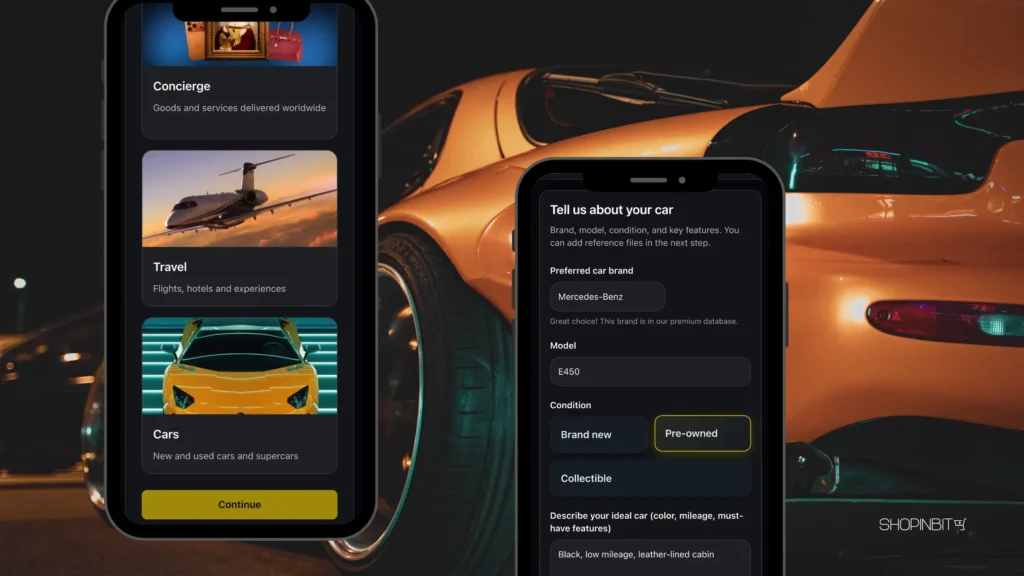
    1. Submit your car request

    To start, you tell us exactly what you’re looking for:

    • car model, budget, and location
    • new or used vehicle
    • specific features, preferences, or constraints

    The easiest way to submit your request is through our web app:

    👉 https://app.shopinbit.com/

    It’s a simple chat interface designed to ask the right questions upfront—so we can focus on sourcing the right car for you, not just what happens to be available on the market.
    2. Work with a car specialist

    You’ll be connected with a real human car concierge who specialises in vehicle sourcing.

    We clarify your requirements, challenge assumptions where needed, and make sure we’re searching for the right car—not just the fastest or most convenient option.

    Once you book the search (€223 incl. VAT, credited toward your purchase), we begin a structured car sourcing process tailored to your request.

    The goal is simple: help you buy a car with crypto confidently—and make a decision you won’t regret later.

    3. We research, verify and compare offers

    We search across multiple markets to find the best cars available for your request. We contact sellers and dealerships, verify key details and compare offers on your behalf.

    This includes checking availability, vehicle condition, and documentation—while also negotiating where possible.

    The goal is to present you with the strongest options on the market, without overwhelming you with endless listings, while staying available as a trusted second opinion throughout your decision process.

    4. Purchase and pay in crypto

    If you decide to proceed, you can pay using:

    • Bitcoin (BTC)
    • Monero (XMR)
    • USDT
    • or 2000+ cryptocurrencies via our Exolix integration

    From your perspective, the process is straightforward: you choose a car and we coordinate the transaction and next steps.

    What you actually pay for

    Our service includes a ~10% concierge fee on top of the car price.

    This covers:

    • vehicle sourcing and market research
    • communication and negotiation with sellers
    • verification and coordination
    • logistics support

    You’ll also need to consider:

    • transport costs
    • import duties (if applicable)
    • registration and local compliance

    Privacy vs anonymity: what this really means

    One of the most common misunderstandings is around privacy.

    Let’s be clear:

    👉 We do not offer anonymous car purchases. We offer privacy.

    No matter where you buy a car:

    • it has to be registered in someone’s name
    • registration requires legal identity
    • this applies whether you pay in cash, bank transfer, or crypto

    We do emphasise privacy.

    • You don’t create a customer account or use email: requests are sent through our web chat interface.
    • We keep personal data minimal and delete it from online storage after a period (e.g. 30 days after shipment).
    • We don’t use tracking tools like Google Analytics or Pixel.
    • We do not share your data with dealership, the transaction is between you and us.

    “Private” here refers to data minimisation and no invasive KYC procedures and the transaction itself will require real details (e.g. delivery address),

    If you’re concerned about privacy in vehicle purchase beyond data hygiene, ask specifically – the exact legal requirements depend on your country.

    What data you need to provide

    When finalising the purchase, we require:

    • the name of the person registering the car
    • the address from their passport or official ID

    This must appear on the invoice — otherwise, the car cannot be registered.

    Outside of that, we keep data collection minimal and do not store it longer than necessary.

    How crypto fits into this

    From a legal and documentation perspective:

    • the car purchase is treated as a standard prepaid transaction
    • the invoice states the car was paid in full in advance
    • the invoice is issued in EUR and PLN (as we are a Polish company)
    • there is no mention of cryptocurrency on the invoice

    So practically:

    👉 you bought a car — the payment method is separate from the paperwork

    So why buy a car with crypto through ShopinBit?

    If anonymity isn’t possible, what’s the point? Here’s the real value and it’s not theoretical.

    1. Avoid banking issues related to crypto

    A common scenario:

    • You send crypto to an exchange
    • Convert to fiat
    • Transfer to your bank
    • Your bank flags you as high risk
    • Worst case: your account gets restricted or closed

    With our approach you spend your crypto directly and without routing large amounts through your bank.

    2. Reduce risk when buying a car

    Even if you buy with fiat, buying a car still comes with risks:

    • hidden damage
    • incorrect documentation
    • stolen vehicles
    • overpriced deals

    We act as a second layer of protection by:

    • verifying vehicles and sellers
    • comparing offers across markets
    • helping you avoid obvious mistakes

    3. Get guidance (especially if you’re not a car expert)

    If you’re not deeply familiar with: car markets, dealerships, pricing, negotiation – then having someone experienced on your side can prevent costly errors.

    What We Can (and Can’t) Handle

    We can help with:

    • Sourcing vehicles internationally, from daily rides to supercars, also campers, motorcycles, boats or even tractors.
    • Dealer communication
    • Preparing offers and coordination
    • Logistics and professional transport

    Things that may still require local handling:

    • local homologation/adaptation (lights, emissions, paperwork) for your jurisdiction with local providers. If possible we may do this for you.
    • warranties and post-sale servicing of new cars is handled with the dealership so we will connect you with the right one.

    Price transparency

    A common question is how our pricing compares to local classifieds.

    We search across multiple markets, dealerships, and partners, using our network and car specialists to compare options more broadly — not just by price, but by condition, history, and overall value.

    Our focus isn’t on pushing quick deals, but on helping you make a sound decision. We stay involved throughout, helping you assess options and understand the trade-offs before you commit.

    Closing thoughts

    Buying a car with crypto isn’t just about payment: it involves multiple parties, regulations, and potential risks, especially across borders.

    Some prefer handling everything themselves. Others value having support with sourcing, verification, and coordination.

    Our role is to make the process simpler and clearer, so you can focus on choosing the right car, not managing the complexity behind it.

    Open a chat with us and see how easy it is to have your next car delivered to your door.
  • PARAGUAY. Looking beyond Europe: Crypto-friendly countries and new tax residencies.

    PARAGUAY. Looking beyond Europe: Crypto-friendly countries and new tax residencies.

    Why Paraguay is on the radar

    Over the last decade, Europe has become increasingly regulated. Financial surveillance has intensified, reporting obligations have multiplied, and the scope for personal and economic privacy has narrowed at a noticeable pace. Even countries that were once considered relatively relaxed are now implementing MiCA and broader compliance frameworks.

    For crypto holders, entrepreneurs and internationally mobile individuals, this raises a practical question alongside the ideological one:
    Where can you live, work and invest without constant friction?

    This blog series explores jurisdictions outside the mainstream migration narrative — countries that combine reasonable tax frameworks, flexible residency rules and a pragmatic approach to cryptocurrencies. Just as importantly, we look at places that still offer room for new opportunities, business development and long-term optionality.

    We will move across continents, from South America to Africa and Southeast Asia, analysing destinations such as Paraguay, Mauritius and Cambodia.

    This first article focuses on Paraguay — a country that still rarely appears in glossy relocation brochures, yet continues to surface in conversations among Bitcoiners, digital nomads, miners and long-term crypto investors.

    What this article covers

    This piece looks at Paraguay from the perspective of a crypto holder considering relocation, global mobility or a second residency. We will cover:

    • Why Paraguay is attracting investors, including crypto investors
    • How Paraguayan residency works in practice
    • Tax residency rules and the territorial tax system
    • The legal and practical status of cryptocurrencies
    • Energy and infrastructure considerations for Bitcoin mining
    • Crypto events across the Mercosur region, and why Paraguay can be a strategic base
    • Cost of living, advantages and limitations of relocating.

    This is not a lifestyle pitch. The aim is to present a realistic overview based on current regulations and on-the-ground conditions. The article only scratches the surface, but we point to reliable sources for further research at the end.

    Why Paraguay?

    Paraguay sits quietly in the centre of South America, bordered by Brazil, Argentina and Bolivia. It has no coastline, no mass tourism industry and little international media attention — which is precisely part of its appeal. From a crypto and expat perspective, Paraguay offers a rare combination of features: 

    • Territorial tax system – foreign-sourced income is generally not taxed
    • Straightforward residency system – low barriers to entry and easy to maintain
    • Abundant, inexpensive electricity – largely hydroelectric
    • A largely permissive environment for cryptocurrencies
    • Low cost of living and property compared to Europe and the US.

    Paraguay is not marketing itself as a “crypto hub”. Instead, it offers something many crypto holders value more: regulatory calm, relative freedom and administrative simplicity.

    Residency in Paraguay: how it works

    Paraguay is known for having one of the most accessible residency programmes globally. In practice, almost anyone with a clean criminal record can obtain legal residency, making Paraguay a popular “Plan B” jurisdiction.

    Types of residency in Paraguay

    Temporary residency

    Temporary residency is often the first step and suits those who want to explore the country without long-term commitments.

    • Valid for two years
    • Can be converted into permanent residency after this period
    • No investment requirement and no minimum income threshold.

    Applicants typically need:

    • A valid passport
    • Birth certificate with apostille
    • Criminal record certificate with apostille.

    With temporary residency, you can legally work, run a business and access local banking. Importantly, Paraguay does not require continuous physical presence. In practice, visiting the country once every two years is sufficient to maintain the status and later apply for permanent residency. After residency approval, you can obtain a Paraguayan ID card (Cédula de Identidad), valid for ten years. This document allows you to:

    • Verify identity with public and private institutions
    • Register on cryptocurrency exchanges
    • Travel within Mercosur countries (e.g. Argentina)
    • Open bank accounts locally and abroad
    • Obtain a tax number (RUC) if needed.

    You can also apply for a local driving licence once the cédula is issued.

    Permanent residency

    Permanent residency is granted without an expiry date, with the administrative document renewed every ten years. Key points:

    • Absence of up to 36 months without losing status
    • Eligibility to apply for citizenship after three years
    • No need to repeat the full residency process.

    While Paraguayan citizenship is possible, it is time-consuming and discretionary. For most crypto holders, permanent residency alone is sufficient for comfortable long-term use of the country.

    Residency by investment (SUACE Programme)

    For those who want to skip the temporary stage, Paraguay offers a residency-by-investment route.

    • Minimum commitment: USD 70,000 over 10 years
    • No need to deposit the full amount upfront
    • A business plan outlining use of funds is sufficient.

    Eligible investments include services, trade or agricultural land. The aim is to encourage the establishment of companies within Paraguay. The process typically takes around three months and involves obtaining an investor certificate from SAUCE. Administrative costs are roughly USD 14,000.

    Compared to similar programmes globally — and even regionally (e.g. Uruguay) — this remains a competitive option.

    Tax residency and the territorial system

    Paraguay operates a territorial tax system, meaning:

    • Income generated outside Paraguay is generally not taxed
    • Local income is taxed at low, flat rates.

    Maximum rates currently stand at:

    • 10% personal income tax (IRP)
    • 10% VAT (IVA).

    For crypto holders earning from foreign exchanges, on-chain activity or international businesses, this distinction is crucial. Capital gains on cryptocurrencies held and traded abroad are, under current practice, not taxed locally if not sourced in Paraguay.

    Becoming a tax resident

    Tax residency is separate from immigration residency. To become a tax resident, you need to obtain a RUC (tax identification number). Important considerations:

    • RUC is not mandatory for residency
    • Once obtained, monthly VAT filings and annual income declarations are required — even if local income is zero.

    You should only apply for RUC if you actually need tax residency or certification.

    Key steps include obtaining the RUC, registering with the tax authority, meeting presence requirements and applying for a tax residency certificate.

    Cryptocurrencies in Paraguay

    Legal status

    Cryptocurrencies are legal to hold, trade and use in Paraguay. While regulation is discussed periodically, there is currently:

    • No blanket ban on crypto assets
    • No targeted capital controls
    • No comprehensive crypto-specific tax regime.

    Crypto operates in a largely tolerated and lightly regulated space — a contrast to increasingly prescriptive frameworks elsewhere.

    Blockchain and crypto events in the Mercosur region

    One overlooked advantage of Paraguay is its position inside the wider Mercosur area, which includes Brazil, Argentina, Uruguay and Paraguay. For crypto holders who are not only investing but also building, networking or scouting opportunities, this regional ecosystem matters. Paraguay itself remains relatively quiet — but the surrounding region hosts some of the most relevant blockchain and Web3 gatherings in Latin America.

    Brazil: institutional scale and global capital

    Brazil, particularly São Paulo and Rio de Janeiro, is often the gateway for international funds, fintech operators and large-scale tech conferences.

    Notable events include: 

    • ICAINSBT (International Conference on AI, Network Security and Blockchain Technology) São Paulo — 26 March 2026;
    • ICBC (International Conference on Blockchain and Cryptocurrency) São Paulo — 8 April 2026;
    • Web Summit Rio (Rio de Janeiro) — 8–11 June 2026. Not strictly crypto-focused, but one of the easiest places in the region to meet global delegations, VC and big tech. Web3 and fintech regularly appear through side events.

    Argentina: Bitcoin culture and developer density

    Argentina remains one of the strongest crypto markets in the region, with an established Bitcoin community and high developer presence. Key gatherings include:

    • LABITCONF (Buenos Aires) — 8 May 2026. One of the best-known Bitcoin and crypto conferences in Latin America, with strong international attendance.
    • ETHGlobal Buenos Aires — 21–23 November 2025 (last edition). Part of the global ETHGlobal hackathon series, a top format for meeting developers, teams and technical partners.

    Uruguay: smaller market, strong professional networks

    Uruguay’s ecosystem is smaller, but Montevideo regularly hosts recognised Web3 gatherings.

    • ICBC Montevideo (International Conference on Blockchain and Cryptocurrencies)
    • Blockchain Summit Global Montevideo — January 2027. One of the most recognised annual blockchain and Web3 conferences in LATAM.

    Paraguay: an emerging hub worth watching

    Paraguay is starting to build its own event layer, with increasing focus on regulation, tokenisation and adoption.

    • Paraguay Blockchain Summit. Positioned as the country’s leading event for crypto, finance and technology, connecting startups, investors, regulators and regional media.
    • ICACNS (Applied Cryptography and Network Security)Ciudad del Este — 25 February 2026
    • ICBC Paraguay (Blockchain and Cryptocurrency Conference) Ciudad Del Este — 25 February 2026
    • ICBTA (Blockchain Technology and Applications) 1 March 2026

    For residents based in Paraguay, these events are reachable within a short flight — making the country a practical base inside a growing Latin American crypto corridor.

    Bitcoin mining and energy

    Paraguay’s energy profile is one of its strongest advantages. Thanks to massive hydroelectric projects such as Itaipú, the country produces far more electricity than it consumes. This results in:

    • Some of the lowest electricity prices in the region
    • Strong interest from Bitcoin miners
    • Ongoing political debate focused on regulation, not prohibition.

    While rules may evolve, the underlying energy surplus is structural, giving Paraguay long-term relevance for proof-of-work infrastructure.

    Recent developments also suggest that the government is beginning to see Bitcoin mining as a potential strategic use of surplus energy. In March 2026, Paraguay announced plans to explore a state-run Bitcoin mining initiative using mining rigs confiscated from illegal operations. The project would involve cooperation between the state electricity company ANDE and infrastructure partner Morphware, with the aim of deploying these machines using excess hydroelectric capacity. A memorandum of understanding has already been signed to formalise the collaboration. While mining regulations may continue to evolve, the underlying energy surplus is structural rather than temporary. This keeps Paraguay relevant in long-term discussions about proof-of-work infrastructure and energy-backed Bitcoin mining.

    Cost of living and property

    Foreigners can purchase property without major restrictions. Prices remain low, especially outside Asunción. A comfortable lifestyle is achievable for USD 900–1,300 per month, significantly less outside the capital.

    According to Numbeo (https://www.numbeo.com/), the cost of living in Paraguay is as follows:

    • The estimated monthly costs for a single person are 410.3€, excluding rent.
    • Cost of living in Paraguay is, on average, 59.4% lower than in United Kingdom and 59.7% lower than in Germany.
    • Rent in Paraguay is, on average, 69.9% lower than in United Kingdom and 59.7% lower than in Germany.

    Additional housing costs in Paraguay: the housing budget includes additional charges, such as electricity, air conditioning and/or heating, as well as water and garbage collection. These costs are around 375,100 PYG per month, or just over 43 EUR. The price per kWh of electricity is PYG 404 (EUR 0.047) (source: https://www.foyerglobalhealth.com/destination/the-cost-of-living-in-paraguay/)

    What doesn’t work well in Paraguay

    Paraguay has clear limitations:

    • Limited access to specialised healthcare
    • Inefficient and unreliable public transport
    • Underfunded public education system
    • Good-quality schooling mainly available through private (often international) schools in Asunción.

    These factors matter particularly for families and should be considered carefully.

    Paraguay in perspective

    Paraguay offers a rare combination: a favourable tax framework, low living costs, a simple residency process and minimal physical presence requirements. It works especially well for digital nomads, entrepreneurs, investors and those seeking a long-term Plan B outside heavily regulated systems. Paraguay is not for everyone. It lacks the polish of Western Europe and the infrastructure of global financial centres. What it offers instead is space — regulatory, financial and personal. Paraguay may be a good fit if:

    • Most of your income is earned abroad
    • You value flexibility over permanent relocation
    • You prioritise low costs and financial freedom
    • You work remotely and travel internationally
    • You are looking for a stable jurisdiction for asset allocation, including property. 

    In the next articles in this series, we will move beyond South America and examine other jurisdictions that approach crypto, taxation and residency with similar pragmatism.

    — — — — — —

    Editorial partner: Residency in Paraguay — a team supporting foreign investors with residency, tax numbers and property acquisition. More information: https://getresidencyparaguay.com

    — — — — — —

    This article is part of ShopinBit’s ongoing series on crypto-friendly countries and alternative tax residencies. It is for informational purposes only and does not constitute legal or tax advice.